domingo, 13 de maio de 2018

Vertical Causation (I): Matter and Form (by Raphael de Paola)


The subject of change and motion has always baffled the human mind, arousing many seemingly unanswerable questions. Depending on the answers given, one may wind up faced with insurmountable aporias. Aristotle was well aware of the dangers posed to Greek thinking before him and strove to address them, appropriating the discoveries of his predecessors and integrating them into a framework that to this day remains definitive, both in its general formulation and in its immense plasticity to accommodate new discoveries, which include those of modern science.
Thales, Anaximenes, and Heraclitus each proposed that the world is composed, respectively, of water, air, and fire; Empedocles then proposed the traditional “four elements” of water, air, fire, and earth. Aristotle understood all of these as answering to the question, What are all things made out of?  Perplexed by the all-pervading experience of change and motion in the world, the Presocratic philosophers sought an anchor — a unique, unitary principle that played the role of substratum  to all change. Their reasoning was that in every change there must be something that persists. In agreement on this basic principle, Aristotle proposed that no change in an object can be so radical as to eradicate everything that existed before the change and produce something entirely new. He proposed that some unchanging principle must be maintained throughout any process of change — something that does not change during the process-of-change itself — and concluded that it was this radical principle that his predecessors, while unconsciously searching for, were unable to fully glean. This principle was dubbed matter  (Gk. hylê;  Lat. materia:  wood, timber): A principle out of which  something can be made — as in how “wood” stands to things like chairs, tables, and shelves. Matter is a necessary principle for the reason that to deny its being at work is to assume that each time an object undergoes a change of some kind, the original object disappears into nothing  whilst a new object springs up entirelyfrom  nothing. Well-versed as he was in the Parmenidean aporias regarding nothingness, Aristotle considered such an interplay between reality and “pure nothing” to be absurd, and thus embraced the material  principle as a necessary explanatory “pole” of reality.
As a principle that bespeaks of the commonality of all beings, one of the marks of the notion of matter  is precisely this: that which remains during the process of change. But this material principle cannot be the whole story. Having established that all reality is, in its material aspect, one in the same, we must also account for the immense variety of the things we see in the world. Given the principle of sameness  on the level of matter, there must also be a complementary pole comprising a principle of difference, a principle of heterogeneity as well as of homogeneity. Now the principle of homogeneity is that which we call matter, which accounts for the fact that things can transform one into another without completely disappearing in to, or emerging from, direct nothingness; the mere fact of change itself is enough to convince us of this.

“As a principle that bespeaks of the commonality of all beings, one of the marks of the notion of matter is precisely this: that which remains during the process of change.”

Whatever the ultimate constituent of reality is — call it, for the sake of argument, “water” — it cannot be the case that it is the sole principle of reality. To say that “everything is made out of  water” is not the same as to say that “everything is only water.” At the very moment we say “everything is only  water” we imply that change does not exist at all, because water is already “water,” and nothing can become  what it already is.  All philosophies that tend toward a materialistic monism thus deny the intrinsically undeniable, namely, the existence of change. If, as Democritus held, everything is “just atoms and the void,” then there can be no such events as, say, a cow dying or an apple being digested; the description of such processes as these amounts to mere “opinion” in such a philosophy.
In order to cope with the world as it shows itself to the unprejudiced mind — that is, in order to seriously entertain the reality of change — Aristotle incorporated, as a second  tenet of his explanatory system, the principle of form. If matter  is the principle present indifferently in all things, form  is what differentiates each thing from all other things: matter is the principle of homogeneity, and form the principle of heterogeneity. Referring back to the hypothesis that all matter is aqueous, we would say this red juicy thing here is water in the form  “apple,” and that the blue, noisy thing there is water in the form  of “bird.” While the concept of matter answers the question of what something is made of, the concept of form answers the question of what something is,  its essence. By definition, then, and in opposition to matter, form is an immaterial  principle. Aristotle proposed that every concrete being is a synolon  composed of the co-principles matter and form — more specifically, prime matter and substantial form.
Fonte: philos-sophia.org
Raphael De Paola is a physicist from Rio de Janeiro, where he teaches at the Pontifical Catholic University (PUC-Rio). After taking his doctorate in theoretical physics in 2000, he subsequently turned to philosophy. Having long recognized the decisiveness of Wolfgang Smith’s ontological resolution to the quantum reality problem, and the urgency of its need to be as widely disseminated as possible, he took it upon himself to translate The Quantum Enigma into Portuguese in 2011 — a book which, in his estimation, could very well be entitled “The Solution of the Quantum Enigma.”

segunda-feira, 2 de abril de 2018

A inteligência não é o fundo do nosso ser (Ortega y Gasset)

Resultado de imagem para jose ortega y gasset

A inteligência não é o fundo do nosso ser. Pelo contrário. É como uma pele sensível, tentacular que cobre o resto do nosso volume íntimo, o qual por si é sensu stricto ininteligente, irracional. Barrès dizia isto muito bem: L'intelligence, quelle petite chose à la surface de nous. Aí está ela, estendida como um dintorno sobre o nosso ser mais interior, dando uma face às coisas, ao ser - porque o seu papel não é outro senão pensar as coisas, pensar o ser, o seu papel não é ser o ser, mas reflecti-lo, espelhá-lo. Tanto não somos ela que a inteligência é uma mesma em todos, embora uns dela tenham maior porção que outros. Mas a que tiverem é igual em todos: 2 e 2 são para todos 4. Por isso Aristóteles e o averroísmo acreditaram que havia um único noûs ou intelecto no Universo, que todos éramos, enquanto inteligentes, uma só inteligência. O que nos individualiza está por trás dela. 
Mas não vamos agora espicaçar uma tão difícil questão. Baste o que foi dito para sugerir que em vão pretenderá a inteligência lutar num matchde convicção com as crenças irracionais, habituais. Quando um cientista sustém as suas ideias com uma fé semelhante à fé vital, duvida da sua ciência. Numa obra de Pío Baroja, uma personagem diz a outra: «Este homem acredita na anarquia como na Virgem do Pilar»; o que é comentado por uma terceira: «Em tudo o que se acredita se acredita igualmente». 
Do mesmo modo, sempre a fome e sede de comer e beber será psicologicamente mais forte, terá mais energia bruta psíquica que a fome e a sede de justiça. Quanto mais elevada for uma actividade num organismo, é menos vigorosa, menos estável e eficiente. As funções vegetativas falham menos que as sensitivas, e estas menos que as voluntárias e reflexivas. Como dizem os biólogos, as funções adquiridas ultimamente, que são as mais complexas e superiores, são as que primeiro e mais facilmente são perdidas por uma espécie. Em outros termos: o que vale mais é o que está sempre em maior perigo. Num caso de conflito, de depressão, de paixão sempre estamos prontos a deixar de ser inteligentes. Dir-se-ia que levamos a inteligência presa com um alfinete. Ou dito de outra maneira: o mais inteligente é-o... às vezes. E o mesmo poderíamos dizer do sentido moral e do gosto estético. Sempre no homem, por sua própria essência, o superior é menos eficaz que o inferior, menos firme, menos capaz de se impor. 

Ortega y Gasset, in 'O Que é a Filosofia?'

sábado, 31 de março de 2018

O pensamento filosófico romano pode ajudar a lidar com a depressão

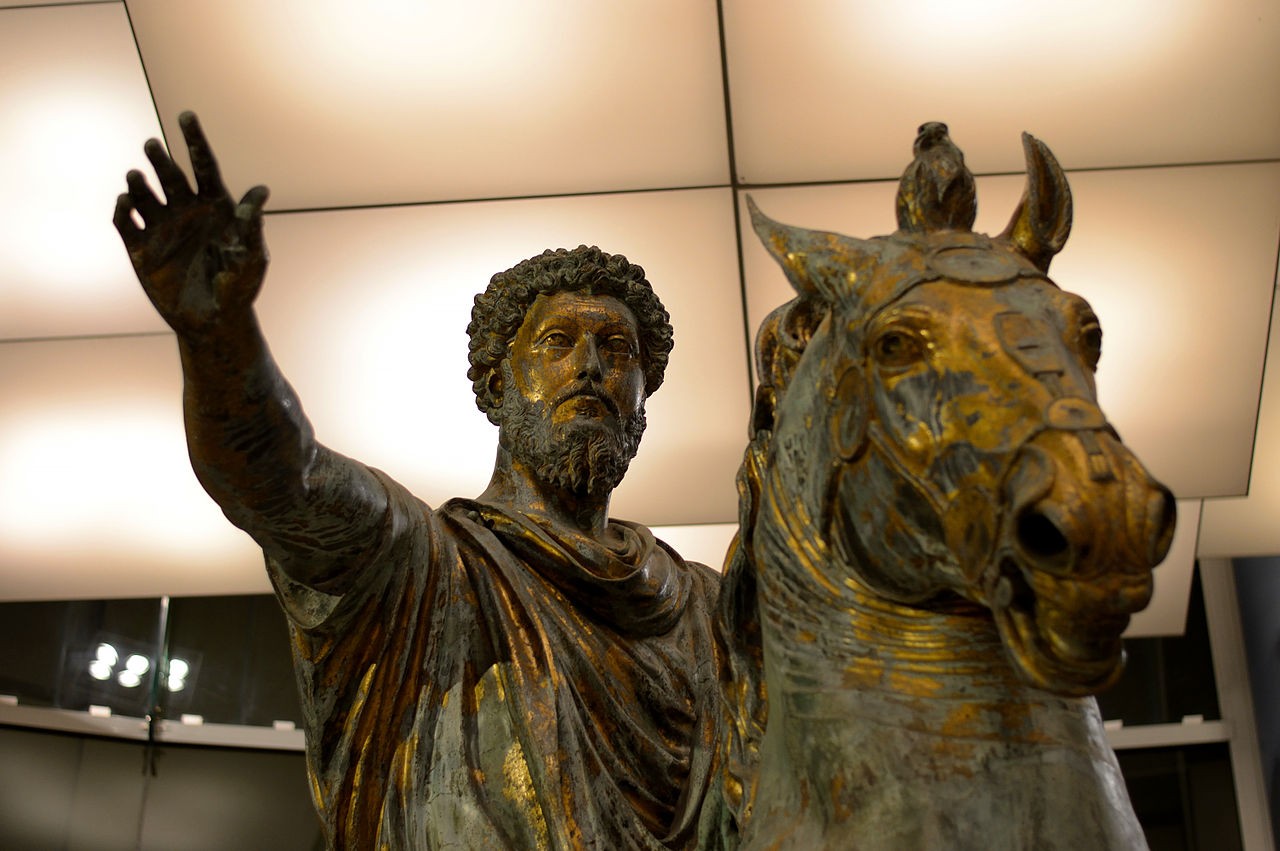
Estátua de Marco Aurélio no Museu Capitolini, Roma (Foto: Wikimedia Commons)
Adepressão está em ascensão. Um estudo realizado pela Organização Mundial de Saúde encontrou um aumento de 20 por cento nos casos de depressão em apenas uma década.
Eu trabalho em um campus universitário. Pode-se esperar que tal lugar seja vibrante e enérgico, mas ultimamente parece haver mais fadiga e mal-estar. Mesmo para mim, em alguns dias pode ser difícil enfrentar o mundo.
Como estudioso da filosofia antiga e estóico praticante, encontrei grande consolo nas obras de filósofos estóicos romanos, como Marco Aurélio, imperador de Roma e Epicteto, professor de filosofia estóica e ex-escravo.
Que ferramentas esses antigos pensadores oferecem para lidar com a depressão?
Claro, devo acrescentar aqui que a depressão clínica, que é um grave problema de saúde e deve ser tratada por um profissional, é uma questão diferente do tipo de depressão e fadiga comuns que a maioria de nós pode sentir de vez em quando.
O que é estoicismo?
O estoicismo baseia-se na ideia de que o objetivo da vida é viver de acordo com a natureza. A própria natureza é definida como todo o cosmos, incluindo os nossos semelhantes.
Epicteto, cuja escola de estoicismo floresceu no segundo século d.C., nos disse como seguir essa ideia. Ele disse: "Algumas coisas estão sob nosso controle e algumas coisas não estão sob nosso controle". E, se algo não estiver sob nosso controle, não vale a pena gastar energia.
No entanto, havia dias, mesmo para esses pensadores, quando eles achavam difícil continuar com seus deveres. Marco Aurélio, que, como imperador do Império Romano de  161-180 d.C era o homem mais poderoso do mundo, deixa claro em uma das passagens de suas Meditações, que ele está lutando para sair da cama. Então, ele diz a si mesmo:
"Estou crescendo para fazer o trabalho de um ser humano. Por que, então, sou tão irritável se eu sair para fazer o que nasci para fazer e o que trouxe para este mundo? Ou fui criado para isso, deitar na cama e me aquecer sob a roupa de cama? "
Ele também reconhece como essa exortação pode ou não ser efetiva alguns dias. Então, mesmo que ele se arraste para o mundo, Marco destaca o que ele pode enfrentar:
"Diga a si mesmo no início do dia, eu vou encontrar com pessoas intrigantes, ingratas, violentas, traiçoeiras, invejosas e insociáveis".
Embora essa observação possa parecer não ser muito útil, na medida em que foca a atenção em todas essas possibilidades e dificuldades negativas, há aqui um ponto estóico muito importante. Alguém pode perguntar, por que se lembrar das dificuldades será benéfico?
Encontrando o mundo em termos estóicos
O filósofo estóico Epicteto fornece uma resposta — pode nos ajudar a antecipar as possibilidades e nos preparar para o que está por vir. Ele diz no Enchiridion:
"Quando você está prestes a realizar alguma ação, lembre-se de que tipo de ação é. Se você for tomar um banho, pergunte o que acontece nos banhos — há pessoas que explodem, pessoas que se empurram, pessoas insultantes, pessoas que roubam. E você assumirá a ação de forma mais segura se, desde o início, você disser: 'Quero tomar um banho e manter minhas escolhas de acordo com a natureza'; e também para cada ação ".
O exemplo de Epicteto do banho romano pode ser adaptado a um contexto contemporâneo considerando o tipo de coisas que podem acontecer no trabalho, enquanto viaja ou em casa.
Epicteto está nos dizendo para estarmos preparados para enfrentar situações com uma atitude realista em relação ao que realmente são as coisas.
Marco Aurélio fornece orientações mais específicas sobre como responder.
"Eu, então, não posso ser prejudicado por essas pessoas, nem ficar irritado com alguém que é semelhante a mim, nem posso odiá-las, pois fomos juntas para trabalhar juntas, como pés, mãos, pálpebras ou as duas fileiras de dentes em nossas mandíbulas superiores e inferiores. Trabalhar uns contra os outros é, portanto, contrário à natureza; e estar com raiva de outra pessoa e afastar-se dela certamente trabalhará contra ela".
Em tudo isso, o que esses filósofos estão nos lembrando é que viver de acordo com a natureza é reconhecer que, mesmo os indivíduos mais difíceis daqueles que podemos encontrar, no decorrer de um dia, podem ser como nós — alguém que talvez esteja lutando com os seus próprios mal-estar ou doenças.
Ao reconhecer isso, é mais fácil perdoar aqueles com quem discordamos. Mas, mais do que isso, talvez seja mais fácil tolerar-nos. Isso nos ajuda a reconhecer o sofrimento e o ser humano.
Sofrimento e sua solução
Essa ideia ecoa quando Epicteto explica a origem do sofrimento humano:
"O que perturba as pessoas não são as coisas em si, mas seus julgamentos sobre as coisas".
Estar chateado com algo não é uma função do que parece "chateante"; Em vez disso, é o julgamento sobre essa coisa que causa a angústia.
Os julgamentos, e não as coisas ou eventos externos, são a fonte do sofrimento humano.
O remédio a tudo isso, de acordo com Epicteto, é realmente apenas uma mudança de atitude em relação às coisas que acontecem. Quando pudermos enfrentar o dia com pleno reconhecimento do que esse dia poderia implicar e reconhecer que ainda devemos continuar, poderemos avançar.
Isso pode significar deixar a concepção de como as coisas deveriam ser e aceitá-las pelo que são, mesmo as mais frustrantes e deprimentes.
Então, "o trabalho de um ser humano" pode não parecer tão assustador.
*Professor Associado, Filosofia, Universidade de Wyoming, nos Estados Unidos. Texto publicado originalmente em inglês no The Conversation. Republicado em Revista Galileu.

quarta-feira, 28 de março de 2018

OS FILÓSOFOS POP NA INTERNET BRASILEIRA

Olá, pessoal! Acabou de sair vídeo novo no canal. Nele comento sobre o fenômeno dos filósofos pop brasileiros. Assistam!


domingo, 25 de fevereiro de 2018

Thinking Ahead (by Nigel Warburton)


Søren Kierkegaard famously pointed out that the only way we can understand life is backwards – we are compelled to live moving forwards, but attempt understanding by looking at what has happened. Perhaps he had Hegel’s Owl of Minerva that only flies at dusk in mind here. For Hegel, as history unfurls we collectively come to a moment of self-consciousness and understanding of what has transpired on a grand scale – symbolised by the Owl’s wisdom. Kierkegaard, a fierce opponent of Hegelianism, was interested in the individual’s experience and not epochal movements in history. Yet, as he made clear, his insight that we individually live forwards and understand backwards doesn’t make things any easier. We’re constantly moving forwards (until death), so we never achieve a perfect resting point from which to look back.
The future is the stuff of planning and daydreams. We all spend many days of our lives musing on it, despite the injunctions of mindfulness gurus to live in the present. In the next hour you’ll probably start thinking about things you need to get on with, and even the words ‘in the next hour’ will probably have triggered thoughts about your immediate future. If we did just live in the moment, in the now, we would lack motivation to go forward, lack direction, and would stumble from one situation to the next. We would probably leave the house without an umbrella, miss appointments, and not have any food in the refrigerator when we got home. Some of us do live like that, but that’s hardly a good thing. Yet the paradox of planning is that we both need to do it, and haven’t really got much of an idea how things will turn out – so much of it feels like a waste of time. Even our rough predictions, based on what seems like good evidence, can be wildly inaccurate.
In his recent book What We Cannot Know, the mathematician Marcus du Sautoy demonstrates the complexity of predicting something as straightforward as the trajectory of a cube, a die, thrown from a known height. The way this object will bounce and spin is extremely difficult to predict even when we know a great deal about the physics involved. The same is true of a double pendulum (a pendulum with a hinged arm). A miniscule difference of angle in the throw will produce radically different results for both the cube and the pendulum. The pendulum might swing smoothly, or go into a complex pattern of backwards and forwards spinning, when dropped from almost exactly the same height. Close analysis of the casino croupier’s angle of throw is unlikely to predict accurately the numbers that will show up on the dice; and knowing roughly the height from which a double pendulum is released does not allow a physicist to give an accurate approximate estimate of its trajectory. This is disconcerting for anyone brought up to believe that scientific prediction of physical systems is pretty straightforward.
Chaos Theory is the branch of mathematics that has developed to describe such situations: we are surrounded by systems that are in principle predictable if we know a great deal about starting conditions, but where in practice accurate prediction is impossible because tiny differences in the present produce such divergent outcomes. This is sometimes known as the ‘butterfly effect’ after the metereologist Edward Lorenz, who asked in 1972: “Does the flap of a butterfly’s wings in Brazil set a tornado in Texas?” He didn’t necessarily think that it did. His question was: given the complexity of causes affecting the weather, is it possible that significantly different meteorological conditions in the US could be caused by even something as gentle and small-scale as the flap of an insect’s wings thousands of miles away? The reason he asked this was because the weather seemed to be a case study in the difficulty of predicting outcomes from approximations.
There is no mysterious ‘chance’ operating here. As David Hume pointed out in the 18th century, we use the word ‘chance’ where we are ignorant of causes. Putting things down to ‘chance’ is just a way of saying we’re not quite sure what’s going on. But with complex systems like the one that gives rise to a tornado, approximate knowledge of the starting conditions may not be sufficient to make even approximate predictions of the outcome (in this case a tornado), since minute differences can be responsible for the system tipping over into one state or another. Lorenz put this nicely in his definition of Chaos:
“When the present determines the future, but the approximate present does not approximately determine the future.”
In my lifetime so much that has happened wasn’t foreseen. So much could have turned out completely differently. In the year I was born, the Cuban Missile Crisis could so easily have escalated to a nuclear war between superpowers.  When I was at school in the 1970s, only the most fanciful of sci-fi authors would have imagined the level of interconnection and global communication made possible by the Internet. The idea that many people would be carrying a small computer in their back pockets, or that there would be driverless cars on the road, would have struck most people as far-fetched.
Today, many people are confidently predicting that robots and computers will soon be doing most jobs. Some are worried that artificial intelligences will take over the world, and won’t have much patience with the comparatively limited intellectual capacities of human beings. Yet who knows what will really happen? Clever people make huge mistakes in their predictions. The philosopher Ludwig Wittgenstein, who had trained as an aeronautical engineer, and was cleverer than most, declared that no one would ever reach the Moon only a few decades before someone actually did.
The solution isn’t to avoid thinking about the future. The solution isn’t to stagger with our eyes closed into disaster. We need to make predictions. We need to contemplate what might happen; what is likely to happen; what might happen if things go horribly wrong. Weather forecasters carry on forecasting, aware that their predictions can occasionally be wildly off the mark for the reasons that Lorenz pinpointed. Like weather forecasters, we should recognise how chaos plays a part in life, and how difficult an activity prediction can be. And like weather forecasters, we need to keep revising our predictions in the light of new evidence in a fast-changing environment. We need to be sensitive to subtle shifts in the present that might have far-reaching implications in the future.
“What’s the worst that could happen?” It’s a question favoured by Cognitive Behavioural Therapists as a way of limiting fear of failure, and one worth asking even if we don’t know the accurate odds of the worst-case scenario coming to pass. Individually and collectively, worst-case scenario risk planning might be what saves us. At worst it will mean we prepare for some disaster that never materialises. There is still the risk, of course, that something much worse than anything we can now imagine takes place. There is the risk too that we will become gloomy and fearful of the future, a state of mind that may itself affect outcomes and limit our success. Rather than encourage that, it might be better to balance out worst-case scenario thinking with musing about the best that could happen. We should spend some time daydreaming about a utopian future to have an ideal to aim at too. There’s always the chance that a flapping butterfly wing somewhere might just tip us over into conditions that move us a step towards that future.

Originally published in: New Philosopher

Why Don't Philosophers Talk About Slavery?

Resultado de imagem para slavery

Chris Meyns on a glaring omission
The emergence and rapid expansion in the 1600s of a transatlantic system of the enslavement of, and commercial trade in, people profoundly shaped the modern world, both materially and intellectually. Many of its effects still reverberate today. Yet when you turn to scholarship on the philosophy of the early modern period, you’ll find a gaping absence. Rarely, if at all, is slavery studied in the history of modern philosophy.
I am, by some counts, a scholar of early modern philosophy, so I’m professionally sensitive to the goings-on in this period. The fact bothers me. This article began as a string of tweets on how the topic of slavery is largely absent from scholarship and teaching of early modern philosophy. Since then I’ve become even more convinced there’s something wrong here.
During the past decade, from January 2007 up to and including December 2016, five top journals that publish articles in History of Early Modern Philosophy (Oxford Studies in Early Modern PhilosophyArchiv für Geschichte der PhilosophieBritish Journal for the History of PhilosophyJournal of the History of Philosophy, and History of Philosophy Quarterly) published 990 original articles combined. Of these 990 articles, only five (0.5%) have slavery as their main theme. None of these five engages squarely with the early modern period. Two address Nietzsche’s tirade against slave mentality, two others cover ancient Aristotle, and a final one turns to the nineteenth-century libertarian John Stuart Mill.
The area 17th/18th Century Philosophy in the popular PhilPapers repository does not even have a leaf category for “Slavery”. For comparison, it does have dedicated subsections for Kant’s ideas on what it takes to be a genius (34 entries) and “The Is/Ought Gap” in Hume’s meta-ethics (27 entries).
Nor is the absence confined to research. A typical “Early Modern Philosophy 101” course will cover sceptical fantasies, social contracts and monadologies, but won’t say anything about enslavement. Even the Diversity and Inclusiveness Syllabus Collection of the American Philosophical Association falls short here. None of the syllabi listed under “History of Philosophy” addresses enslavement. Slavery comes up only twice in this collection, both for courses in social and political philosophy. Why is slavery missing from the history of early modern philosophy?
All this could be an accident. Scholars should just write on what they’re passionate about, right? No one is obliged to study any particular topic. But philosophers aren’t stupid. They’re trained to step back, reflect, and should notice when their passion-driven work morphs into a collective omission.
Perhaps there’s simply little to talk about. A lack of source materials. Did philosophers in early modern times even discuss enslavement?
They did. There are some big name philosophers we know and love. John Locke in his Second Treatise of Government (1690) insists that all “men” are naturally in “a state of perfect freedom … [and] equality”, and that no one could sell themselves into slavery for money, even if they wanted to. Some are quick to celebrate anti-slavery pamphlets, such as Montesquieu’s claim in 1748 that “The state of slavery is in its own nature bad”.
There are also less familiar names. Meet Phyllis Wheatley (1753–1784), one of the first African-American published authors, whose poem “On Being Brought from Africa to America” reflects her own experience. Meet Quobna Ottobah Cugoano (1757–ca. 1791), born in present-day Ghana. He survived abduction and forced labour exploitation at the sugar plantations of Grenada. His Thoughts and Sentiments on the Evil and Wicked Traffic of the Slavery and Commerce of the Human Species (1787) refutes point-by-point all attempts of “barbarous inhuman Europeans” to justify slavery. Cugoano argued for a global duty to liberate enslaved people: “Wherefore it is as much the duty of a man who is robbed in that manner to get out of the hands of his enslaver, as it is for any honest community of men to get out of the hands of rogues and villains.” Meet also Olaudah Equiano's (1746–1797), whose The Interesting Narrative and the Life of "Olaudah Equiano" or Gustavus Vassa, the African, published in 1789, presents a host of considerations about enslavement, dignity and empowerment. And meet Doctor of Philosophy, Anton Wilhelm Amo (1703–1759), originally from Axim (in today’s Ghana) and later associated with the German universities of Jena and Halle. Amo published against slavery, in addition to writing on philosophy of mind and philosophical method. Having experienced enslavement first-hand, these philosophers write from a position of epistemic authority.
There is also a ripple of white European women philosophers, who challenge their own subjugated position in society as one of enslavement. “If all men are born free, how is it that all women are born slaves?”, inquires Mary Astell in Some Reflections Upon Marriage (1706). Judith Drake, in An Essay in Defence of the Female Sex (1696), complains that: “Women, like our Negroes in our Western Plantations, are born Slaves, and live Prisoners all their Lives.” These white women appropriated images from African-Caribbean plantation enslavement to lament their own social condition.
You shouldn’t be embarrassed if you hadn’t heard of these philosophers. Many professionally employed in departments of philosophy would not be able to mention a single one of their works either. The “ossifying effects of canonisation”, as editor of the British Journal for the History of Philosophy Michael Beaney has called it, can be extremely cunning, quietly but surely making us forget scores of significant figures and questions.
With so much material on early modern philosophies of slavery, how is it that this aspect of the period gets left out? The answer is: because it fits uncomfortably with how we like to think of the story of modern science. Early modern writers liberally used the cloak of science and philosophy to provide seeming ‘justifications’ for the enslavement of people. Such episodes smudge the pristine image of our beloved heritage. Yet sometimes, history of philosophy turns ugly real quick.
Systems of slavery have existed in many forms and cultures, from ancient Greek penestae, to the nobi class in early Korean dynasties, Ottoman slave trade, and debt slavery in present-day Europe. An estimated 45.8 million people currently live in some form of enslavement, according to globalslaveryindex.org. Still, the early modern period brought a fundamental, lasting change in conceptions of enslavement.
Societies have always distinguished in- and out-groups. However, many early Greek, Hebrew and Christian societies enabled people of social out-groups to escape their inferior status by converting (religiously), or by assimilating to the practices of the dominant social group. In ancient Greece, for instance, so-called “barbarians” (people whose talk sounded to Greek ears like “bar bar bar”) could assimilate by learning to speak, write and live like a Greek.
In Europe this began to change during the fifteenth century, as Robert W. Sussman charts in The Myth of Race. The Spanish Inquisition introduced a new, biological form of in- and out-group discrimination. Grounds for discrimination began to include not just beliefs, practices or religion, but also considerations about ethnicity, including “purity of blood”. The idea arose that there are biologically different kinds of people. While the discrimination was economically and politically motivated, the surrounding whiff of scientific theory gave it the appearance of justification.
Switching one ground of discrimination for another may seem minor, but was seismic. You can alter your habits, beliefs, and which language you speak. But biological grounds, based on blood, remove this option. In Sussman’s words: “Minority or conquered peoples could not change their identities; they could not convert or assimilate into mainstream society.”
In subsequent centuries, with heightened enthusiasm from European intellectuals, we find these basic ideas expanding into two pernicious fabrications. Fabrication number one is that there are distinct species of humans. Sometimes this idea takes the form that, while all humans share a single origin in God’s creation of Eve and Adam (a view known as monogenesis), due to influences of climate and habit, certain groups of people transformed from the ideal into “degenerate” kinds of human. Sometimes the idea was that not all people actually stem from the same source, but some have a different origin (polygenesis).
Building on this, fabrication number two is that there is a hierarchy determining which of these species was truly, optimally human – which included dimensions such as the capacity for reasoning, civilisation, and moral sense. Sadly unsurprisingly, the white Europeans devising this hierarchy decided that white Europeans come out on top. Other “kinds” of people were said to hold the lower ranks of this of cobbled-together ranking. Kant for instance subdivides humans into “White”, “Black”, “the Hun race (Mongol or Kalmuk)” and “Hindu or Hindustani”, casually noting in his lectures on physical geography that “Humanity is at its greatest perfection in the race of the whites.”
Ideas about hierarchically ordered human kinds were used as post-hoc rationalisations for how Europeans mistreated the local people they encountered on their voyages of conquest. As Sussman puts it:
“Although these discriminating practices began as a result of economic and political conditions, ‘scientific’ theories justifying this kind of racism began to appear in Spain and Portugal in the fifteenth century, and after the discovery of America, they were expanded to justify similar racist ideas toward Native Americans, Asians, and, later, enslaved Africans.”
If Native Americans and Africans were not fully human anyway, it might be okay to mistreat them, exploit their bodies, resources, break up family ties, wipe out personal histories. Europeans invented a concept of race to justify enslavement, and called it science.
Philosopher Charles Mills has conceptualised these early modern events as the forging of a “racial contract”, in his 1997 book by that same title. A variation on the well-known “social contract”, in this racial contract a group of humans, self-designated as “white”, based on certain phenotypical criteria, agrees to categorise all remaining humans as “nonwhite”. They agree to treat whites as full-blown persons, while people of colour are relegated to a status of being less-than-full-persons, or “subpersons”, with an “inferior moral status”. The racial contract, on this view, is an implicit agreement between whites to differentially privilege whites and to exploit the bodies, land, resources and to deny socioeconomic opportunities to those categorised as “nonwhite”. The latter are mere living “objects” the contract governs.
Our much-loved philosophers did not invent these quirks of thought. But, plot twist: their early-adaptor enthusiasm certainly helped cement race-based rationalisations of slavery as intellectually respectable principles.
Locke happily claimed that all people are naturally born free, while also co-authoring the Fundamental Constitutions of Carolina (1669), of which article 110 reads: “Every freeman of Carolina shall have absolute power and authority over his negro slaves, of what opinion or religion soever”, because any other option would infringe on an enslaver’s property rights.
David Hume, still widely cherished for his scepticism about self and causation, was among the first to accept polygenesis, and also held that people of colour were “naturally inferior” to whites. Here’s Hume in his essay “Of National Character” (1748):
“There never was a civilized nation of any other complexion than white, nor even any individual eminent either in action or speculation. (…) Not to mention our colonies, there are Negro slaves dispersed all over Europe, of whom none ever discovered the symptoms of ingenuity; though low people, without education, will start up amongst us, and distinguish themselves in every profession.”
Few things will be able to shatter Kant’s standing as one of the most influential moral theorists of the modern age. But Kant, piggybacking on Hume, launched racist anthropology. Kant accepted polygenesis. Kant proclaimed that in the hierarchical order of human species, only whites could attain freewill, and full moral and rational abilities – be genuine persons. Kant’s moral egalitarianism had a quantifier domain restriction, as it only applied to whites. His prominence allowed these ideas to become entrenched in the classification of humanity until deep into the twentieth century. (Kant’s overt racism is an outlier, as it has by now attracted some scholarly attention.)
Some of our beloved “core” early modern figures absorbed white supremacist ideas into their philosophies, lending them philosophical credibility, and so contributing to propagating them onward for centuries. A continued silence about enslavement in the early modern period hurts philosophy. It does so, of course, because it is historically inaccurate. Philosophers wrote about enslavement at the time, but many of their works are by and large glossed over, omitted. As a result, our understanding of the philosophy of this era is at best limited, selective, sanitised. That hurts.
It also hurts epistemically. We miss out on arguments, insights, alternative conceptualisations. This concerns not just the definitional question – what enslavement is, how it affects people, how people could make it seem justified – but also a host of associated issues about freedom, humanity, debt, property, body and mind, power. Is it a mere coincidence that Spinoza argues that humans are held in a state of “bondage” (“servitude” in Latin) of their emotions? Does it just so happen that Hume, in chronicling the relation between passion and the will, writes: “Reason is, and ought only to be the slave of the passions”? Both authors signal a condition in which one thing (humans, reason) lacks self-governance, and subjugation helps them conceptualise it. We’re apt to miss this when we don’t acknowledge how slavery crept up in philosophical thought around that time.
Personhood often figures prominently on Early Modern syllabi. Descartes in his Discourse on Method and Meditations showed that in a condition of global doubt, an individual “I” can still have certainty that they themselves exist: whenever I think, I am – his cogito, sum. While the cogito functions as a universal formula, performable by all, Mills charges that it only reflects an extremely limited angle on the range of philosophical issues around uncertainty of personal existence.
Someone whose humanity systematically gets ignored based on their phenotype may face radically different problems. Mills writes:
“If your daily existence is largely defined by oppressions, by forced intercourse with the world, it is not going to occur to you that doubt about your oppressor's existence could in any way be a serious or pressing philosophical problem; this idea will simply seem frivolous, a perk of social privilege.”
For someone who gets treated not as a person but like some animate object – Aristotle called enslaved people “living tools” – the core philosophical issue is rather to convince others that she is a person, someone with rationality, moral standing. The bulk of Cugoano’s Thoughts and Sentiments is dedicated to this very purpose.
I cannot help hearing Mills as challenging philosophers, like me, who study the early modern period. These are our heroes, this is our period, it’s our omission if we fail to theorise it. But has the challenge been taken up? Barely. Of the 2,629 citations to Mills’ text (as of August 2017), hardly any are to scholarship on Descartes or early modern philosophy more generally.
Few of philosophy’s seventeenth and eighteenth century heroes spoke out against slavery. Today, few historians of early modern philosophy speak about slavery at all. We can call it an “occupational neglect”. I’m not sure whether enslavement is the right organising principle to confront the relevant philosophical realities. Like genocide, poverty, or sexism, slavery is not to be taken on light-heartedly. It’s not just another research niche. The reality of slavery is ugly. Many still feel a personal stigma around slavery descent; meaningful reparations have not yet materialised. Philosophers should avoid propping up “slavery fan fiction”, as Roxane Gay said of HBO’s planned Confederate alt-history of the American civil war.
But given that enslavement is a fact of the actual world, its pernicious racialised version originating in modern times, any philosopher interested in the facts will somehow have to grapple with it. If we stay silent about philosophical arguments around slavery, it’s as though nothing happened. As if its consequences arose out of nowhere. As student-led campaigns such as “Why is My Curriculum White?” at UCL, “Decolonising the University” at SOAS and “Rhodes Must Fall” at the universities of Cape Town and Oxford have pointed out, many university curricula retain a whitewashed, colonialist slant. If we continue to revere some of its white supremacist figureheads – Kant and Hume were respectively the most and third-most discussed authors in the BJHP between 1993–2013 – while letting “slip” many of the authors interrogating slavery (including women and men of colour, white women), that sends a message. That message is not pretty.
In Raoul Peck’s recent documentary I Am Not Your Negro, James Baldwin voices: “History is not the past. It is the present.” How we write the history of philosophy is the present. We select certain topics, omit others, it has its effects. It’s about time for philosophers studying the early modern period to start talking about slavery.

Originally published in: The Philosopher's Magazine

sábado, 17 de fevereiro de 2018

Apresentação do Arquivo Mário Ferreira dos Santos

O coordenador da Biblioteca Mário Ferreira dos Santos apresenta os resultados obtidos com a organização do Arquivo do filósofo, assinalando a descoberta dos dois datiloscritos que deram origem à primeira edição da obra-prima do autor, “Filosofia Concreta”, publicada em 1957.

A exposição dos dois datiloscritos demonstra de maneira cristalina o cuidado do filósofo com a forma de sua escrita.


segunda-feira, 12 de fevereiro de 2018

POR QUE ESCOLHI A FILOSOFIA?

Decidi contar neste vídeo qual a importância da filosofia para minha
vida e como ela influenciou e tem influenciado minha trajetória
profissional e intelectual. 

quinta-feira, 8 de fevereiro de 2018

O MAIOR FILÓSOFO DA ANTIGUIDADE

Nessa vídeo-aula, falo sobre a vida e obra daquele que foi o mais importante pensador da filosofia grega na antiguidade: Aristóteles. Nela vou apresentar os pontos mais importantes para se compreender a grandeza do legado de conhecimento que esse grande homem deixou ao mundo, destacando sua influência nos mais variados campos, até os dias de hoje.


terça-feira, 6 de fevereiro de 2018

Sócrates e os Sofistas: semelhanças e diferenças

Imagem relacionada
Por Bruno Magalhães
 A filosofia socrática começou a se desenvolver no confronto com a atividade dos sofistas. Sócrates foi um observador crítico desses professores itinerantes que floresceram em Atenas no quinto século antes de Jesus Cristo. Os sofistas eram pagos a peso de ouro para ensinar aos jovens a vencer um debate sem precisar ter razão. Grandes sofistas como Protágoras, Górgias, Hípias e Antifonte não eram, porém, meros professores de retórica, pois buscavam adornar sua atividade e suas teses com uma fundamentação filosófica.
Como já disse em outro post, os sofistas começaram a ganhar notoriedade ao tempo em que as doutrinas dos filósofos físicos começavam a perder o sabor. Eles então se aproveitaram de determinadas linhas de investigação dos físicos e buscaram aplicá-las na resolução dos problemas práticos que uma atividade política nascente suscitava. Com efeito, eles absorveram as diversas ontologias pré-socráticas e a partir delas adotaram atitudes sensitivistas, subjetivistas e relativistas que aplicaram ao campo moral e político. Porém, como eram homens da vida prática e nela pretendiam ver colhidos os frutos de sua atuação, não cogitaram tentar aplicar o método dos antigos físicos, com objeto tão diferente, às suas investidas intelectuais.
Ora, Sócrates também se interessava pelo campo moral e políticoE, assim como os sofistas, também se preocupava com a educação dos jovens (alguns dos quais seriam, em poucas décadas, a classe dirigente em Atenas). A educação a ser dada aos jovens, segundo a concepção de Sócrates, não tratava das especulações cosmológicas, mas sim dos problemas práticos da conduta moral do homem como indivíduo e como parte do corpo social. Nisso também estavam de acordo os sofistas. Porém, Sócrates não buscava educar a juventude para torná-los oradores atraentes com um conhecimento enciclopédico e superficial. O que preocupava Sócrates não era que os jovens estivessem aptos a vencer debates oratórios, mas que estivessem capacitados a praticar o bem, a virtude e a justiça. Em resumo, ao contrário dos sofistas, Sócrates se preocupava na formação moral do homem que atuaria na vida pública, seja como cidadão, seja como governante.
Por tudo isso e por muito mais, Sócrates não foi um sofista — embora com eles tenha sido confundido. É natural que, no início, haja dificuldade de diferenciar uma nova atividade intelectual do pano de fundo do qual surgiu. Sócrates era um esquisitão que fazia um negócio mais ou menos parecido com aquilo que os sofistas faziam. Mas não cobrava dinheiro por isso (o que, convenhamos, tornava a coisa ainda mais estranha). Os objetivos de Sócrates eram bem diversos, e seu método, também. A atividade de Sócrates acabou apontando para uma direção diversa justamente porque, conservando o tema dos sofistas, ele o estudou através de um novo método.
Essa nova direção tomada por Sócrates não é uma questão meramente técnica. Sócrates não ia com a cara dos sofistas, é verdade, e poderia ser tentado a inovar sobre eles simplesmente para com eles não ser confundido. Porém, o buraco é mais embaixo. Sócrates amava sua cidade, a Atenas que com Péricles viveu seu esplendor. Com a Guerra do Peloponeso, viu a decadência de Atenas e a dissolução de suas forças vitais diante dos espartanos. Para ele, parte da culpa pelo lamentável estado de coisas era dainfluência dissolvente dos sofistas, que enfraqueciam a fé na religião tradicional através de seu relativismo cético e proporcionavam um ambiente de desrespeito às leis, aos costumes e às instituições básicas da cidade através da promoção de certo desenraizamento da cidade por seu declarado cosmopolitismo. Sócrates criticou os sofistas também por sua pretensão de saber ilimitado — um saber não-fundamentado que, em realidade, corrompia a alma dos jovens. Isso acontece porque o discurso dos sofistas era independente do pensamento. Daí que ambos, na atividade sofística, não têm suficientes pontos de contato com a realidade das coisas.
Uma vez que Sócrates decidiu trilhar um novo caminho, sua primeira atitude é a de uma retração silenciosa que busca refúgio no não-saber, distante dos palácios dos governadores e dos tribunais de Atenas. Não se trata de renúncia ao conhecimento nem de mero ceticismo. O não-saber socrático o prepara uma nova forma de saber.
Foi nessa sua retração inicial que desenvolveu a noção de alma como a essência do homem, da alma como sua consciência operante e pensante. É difícil para a gente, hoje, ter a exata dimensão da importância dessa descoberta. Antes dele, a alma possuía outras conotações, mas sua operação não estava relacionada à consciência humana e ao guiamento da vida. Nisso Sócrates foi além dos sofistas — aliás, foi além de todo mundo. Sua concepção da alma humana teve evidentes repercussões em sua atividade pedagógica: na Apologia platônica, Sócrates disse perante o tribunal que o julgava que adotara como missão convencer os atenienses que o cuidado com a própria alma era a atividade mais urgente e nobre a que o homem pode e deve se dedicar — e reconhece que nessa atividade talvez ele tivesse algo a ensinar aos outros. Apesar de sua confissão de não-saber e de sua ironia, não  há dúvidas de que Sócrates via a si mesmo como um médico da alma humana, que a conhece e sabe que alimentos lhe fortalecerão em cada caso.
Enquanto os sofistas ensinavam e trabalhavam através de discursos longos e unilaterais (que buscavam convencer a plateia a respeito dessa ou daquela questão), Sócrates percebeu que a verdade é-de ser alcançada por degraus, passo a passo, através do contato entre duas inteligências. Isso o levou a adotar o método do discurso breve, sempre pronto a se adaptar às circunstâncias vivenciadas pelo interlocutor.
Rejeitando a erística dos sofistas, Sócrates inventou a dialética. Compreendeu que para se aproximar da verdade não precisava propriamente da eloquência dos professores de retórica, mas de conhecer aquilo de que se fala e de dar conta dos raciocínios. Enquanto o discurso longo dos sofistas já vem pronto e acabado, o discurso breve tem a vantagem de permitir, em cada passo da pesquisa, as retificações que forem necessárias. Essas mudanças de rumo, muito comuns nos diálogos socráticos de Platão (para não falar da frequente dificuldade de se chegar a alguma conclusão minimamente satisfatória sobre os pontos discutidos), cunharam para muitos de seus ouvintes a imagem de um pensador confuso e desorientado.
Não é mesmo estranho que o homem que disse “a única coisa que eu sei é que não sei de nada” seja o precursor do método científico e o criador da concepção de alma humana que até hoje orienta as reflexões ocidentais? Sim, pode parecer estranho, mas não é de fato. O não-saber socrático, como já disse, é uma espécie de higienização mental e uma forma muito eficaz de abertura à realidade. Ao dizer que nada sabia, é provável que Sócrates estivesse assumindo a posição de quem está disposto a rever todos os seus posicionamentos e suas opiniões (um pouco como fez René Descartes, dezenove séculos depois) e a descartá-los (ou descarteá-los) para dar espaço ao verdadeiro conhecimento. Essa humilde renúncia às próprias opiniões é um ato de confiança na realidade (em verdade é um ato de confiança na divindade, pois Sócrates era um homem piedoso), realidade capaz de nos auxiliar no aprendizado da verdade — verdade que, para alguns, é a adequada coincidência entre o juízo e a realidade.
Post originalmente publicado em: http://astravessias.org/socrates-e-os-sofistas-semelhancas-e-diferencas/

sábado, 3 de fevereiro de 2018

domingo, 21 de janeiro de 2018

ENTREVISTA COM O PROF. AFRÂNIO WEBER FILHO


Entrevista que fiz com o professor de geografia Afrânio Weber Filho​. Foi um papo interessante e divertido, recheado de histórias e vivências, memórias e ensinamentos. Eu gostei demais! Creio que vocês também vão gostar. Assistam!!!

quarta-feira, 17 de janeiro de 2018

DEFEITO ORIGINAL DOS FILÓSOFOS (Por Friedrich Nietzsche)

Resultado de imagem para friedrich nietzsche
"Todos os filósofos têm em seu ativo esse defeito comum de partir do homem atual e pensam, fazendo análise do mesmo, chegar ao objetivo. Involuntariamente, 'o homem' lhes parece como uma aeterna veritas, como um elemento estável no meio de todos os turbilhões, como uma medida segura das coisas. Mas tudo o que o filósofo enuncia sobre o homem nada mais é, no fundo, que um testemunho sobre o homem num espaço de tempo muito limitado. A falta de sentido histórico é o defeito original de todos os filósofos; alguns até tomam, sem se darem conta, a mais recente configuração do homem, tal como se produziu sob a influência de determinadas religiões ou mesmo de determinados acontecimentos políticos, como a forma fixa, da qual é preciso partir. Não querem aprender que o homem evoluiu, que a faculdade de conhecer também evoluiu; enquanto alguns deles até se permitem construir o mundo inteiro a partir da faculdade de conhecer.
Ora, todo o essencial da evolução humana se produziu em tempos remotos, muito antes desses quatro mil anos aproximadamente que conhecemos; nestes, o homem já não pode ter mudado muito. Mas o filósofo vê 'instintos' no homem atual e supõe que estes instintos façam parte dos dados imutáveis da humanidade e, a partir disso, podem fornecer uma chave para a compreensão do mundo em geral; toda a teleologia está edificada sobre isso, de modo que se fala do homem dos últimos quatro mil anos como de um eterno, com o qual todas as coisas do mundo tem, desde seu início, uma relação natural. Mas tudo evoluiu: não há realidades eternas: tal como não há verdades absolutas. Por conseguinte, a filosofia histórica é doravante uma necessidade e, com ela, a virtude da modéstia."