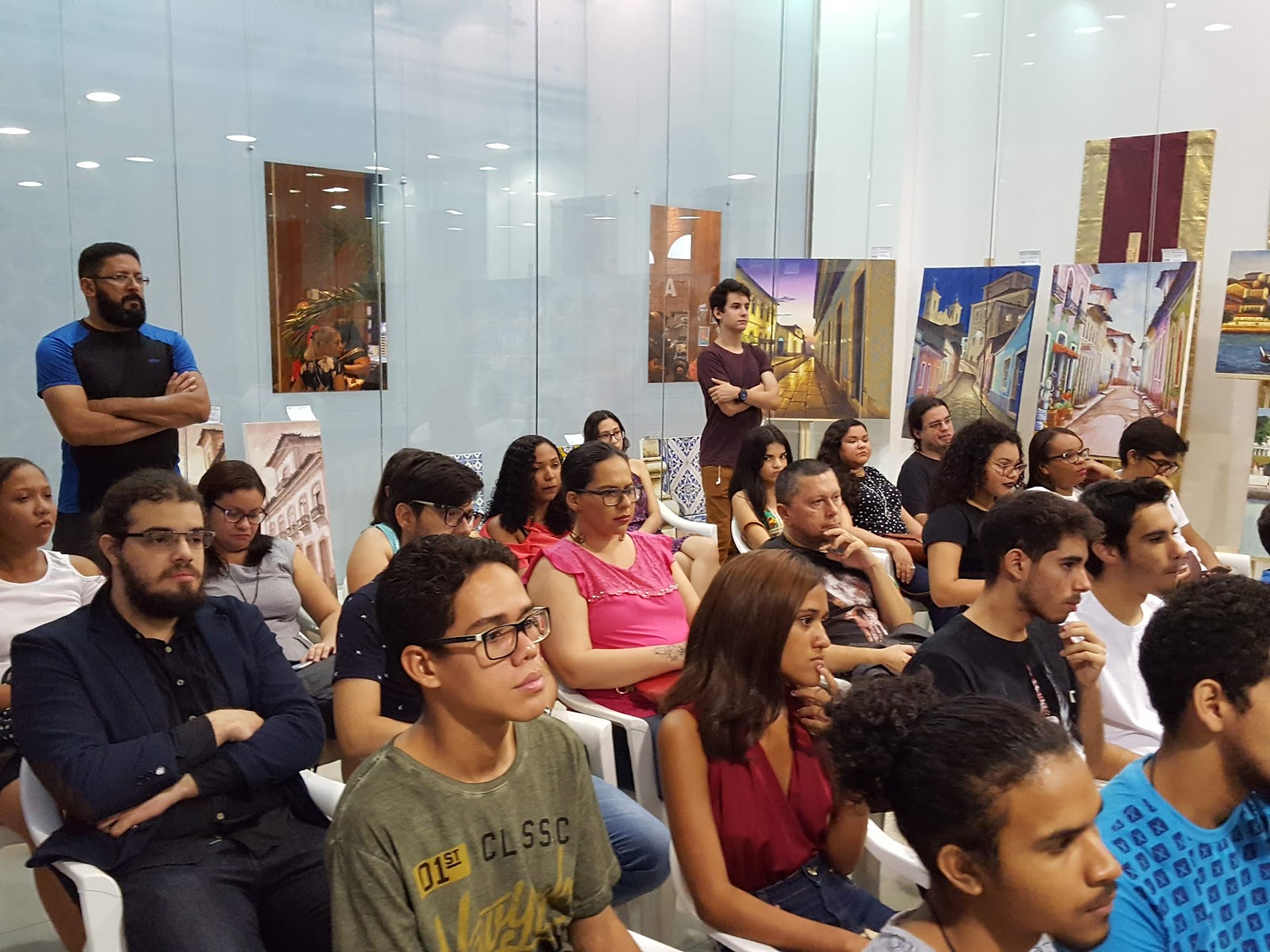
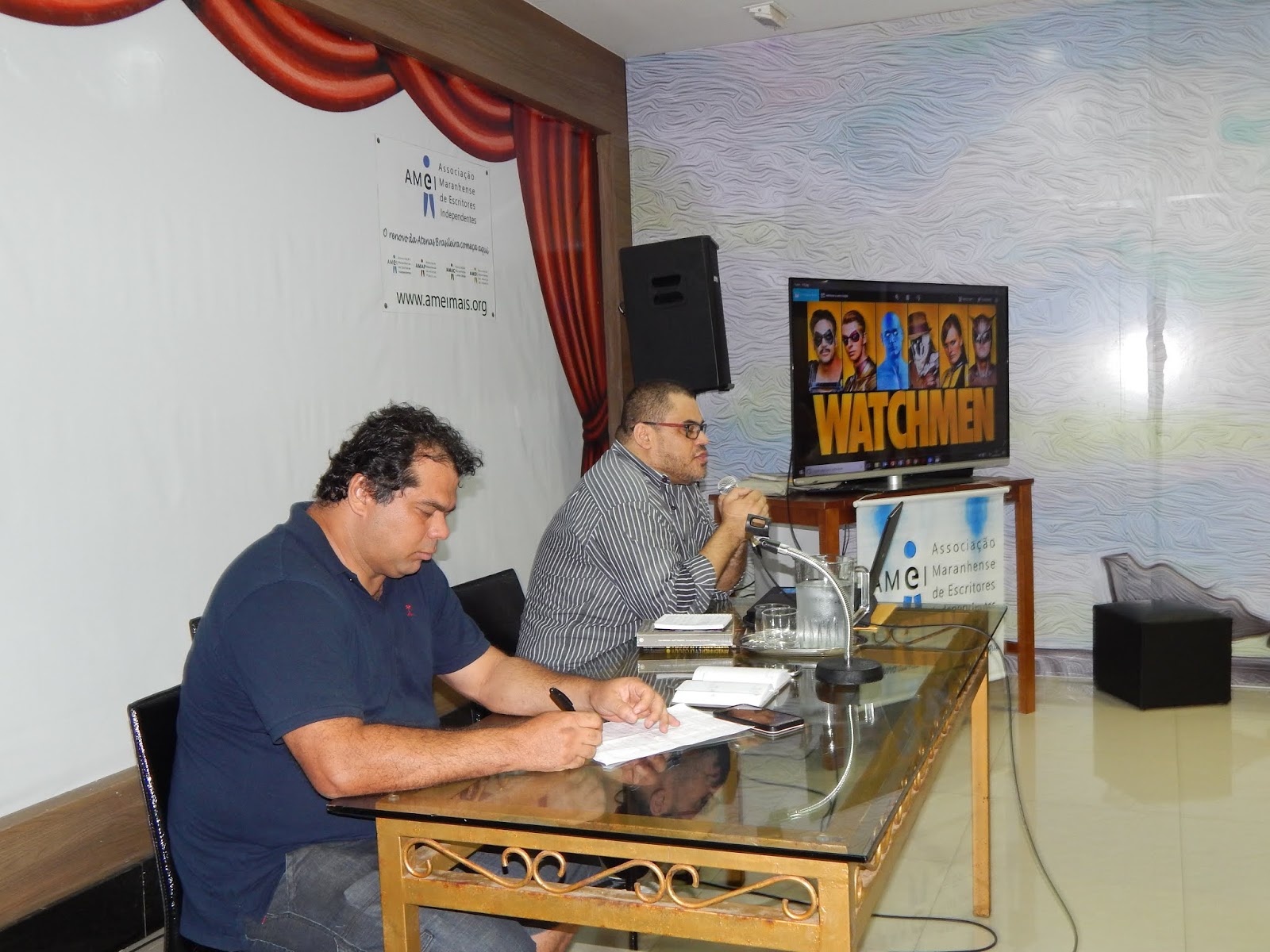
Publico aqui alguns registros fotográficos de momentos do evento de ontem (09/06/2018), realizado no espaço cultural da Associação Maranhense dos Escritores Independentes (AMEI), no São Luís Shopping.
Com a presença dos expositores Marco Aurélio Nogueira e do professor Henrique Borralho, o evento, organizado pela INICIATIVA EIDOS, projeto cultural filosófico e literário comandado pelos professores Rogério Rocha, Marco Rodrigues, Alan Goudard e André Luís, a tarde-noite de ontem foi de muita filosofia e paixão pelos quadrinhos.
Em suas falas, os convidados puderam tecer comentários e realizar análises sobre as obras e personagens mais destacados dos universos das HQ's e graphic novels da história da Marvel Comics e da DC Comics.
Teorias, paralelismos e argumentos que ajudaram o público presente a melhor compreender as relações que se estabelecem entre a ficção e a realidade também estiveram em pauta.
O Café Pensante da INICIATIVA EIDOS, em parceria com a AMEI, é um evento com entrada gratuita que acontece mensalmente, no segundo Sábado de cada mês, nas dependências da Livraria da AMEI, em São Luís. O projeto tem por finalidade criar uma cena cultural voltada para a disseminação, a exposição, o debate e a reflexão sobre filosofia e literatura, em diálogo constante, e como ponto de partida, para conexões com as mais diversas áreas do conhecimento humano.
Para saber mais dos nossos eventos e acompanhar as atividades da INICIATIVA EIDOS, acesse os nossos perfis nas redes sociais:
Hipácia, matemática, astrônoma e uma das mais importantes pensadoras da Antiguidade.
Numa tarde de março do ano 415, durante a quaresma, uma mulher de 60 anos é tirada de sua carruagem por uma multidão enfurecida e arrastada até a igreja de Cesarión, antigo templo de culto ao imperador romano César, em Alexandria, no Egito. Lá é despida e tem sua pele e carne arrancadas com ostras (ou fragmentos de cerâmica ou azulejo, segundo outra versão). Acusada de bruxaria, é destroçada viva pela turba desgovernada. Já morta, arrancam seus braços e pernas. O restante do cadáver é queimado em uma pira nos arredores da cidade. Era o fim da trajetória impressionante da primeira mulher matemática da História e uma das principais filósofas da Antiguidade: Hipácia.
A intelectual, professora carismática que inspirou alguns dos grandes cérebros de seu tempo, tinha influência em diversas esferas da vida pública. O prefeito da cidade, Orestes, indicado por Roma, a consultava antes de muitas de suas decisões. Por isso mesmo, ela tornou-se um obstáculo para a sede de poder de Cirilo, bispo de Alexandria, inimigo político do também cristão Orestes e, possivelmente, o mentor do assassinato da filósofa.
Nascida numa cidade em que diversas religiões conviviam, ela era pagã. Pouco ia ao templo. Tinha entre seus pupilos muitos alunos cristãos, como Sinésio de Cirene, futuro bispo de Ptolemaida. Suas cartas para Hipácia e outros discípulos são o principal registro sobre ela, a quem adorava. A religião nunca foi um empecilho entre eles.
No momento em que vive Hipácia, temos uma sociedade em tensão por causa das mudanças político-religiosas. Há vários relatos sobre hostilidades entre judeus e cristãos e cristãos e pagãos.
A relativa tolerância religiosa de outrora foi inteiramente abalada pelo radicalismo. Seitas foram expulsas de Alexandria e, cada vez mais, a população era insuflada contra elementos de destaque que poderiam ser considerados uma ameaça à expansão de poder do cristianismo
É nesse contexto que Cirilo resolve investir contra a filósofa. Em 413, o bispo já havia expulsado os novacianos e os judeus de Alexandria. Pouco depois, monges atiçados por ele atacaram Orestes, com quem travava uma violenta disputa por poder e influência nos rumos da capital do Egito. Convencido de que Hipácia representava a grande força por trás do prefeito, Cirilo instigou seus seguidores a espalharem pela cidade o boato de que a filósofa era uma bruxa, que usava magia negra para controlar Orestes. A calúnia visava exatamente apavorar a população.
A boataria avançou entre as camadas mais simples da população. Até que, liderada por um homem conhecido como Pedro, o Leitor, uma turba decidiu linchá-la.
A morte da última grande filósofa da Antiguidade clássica deixou toda uma tradição lógica na penumbra durante séculos, até ser redescoberta pelo Renascimento.
Não se sabe nada de Orestes depois da morte de sua mestra. Provavelmente fugiu, deixando a cidade à mercê de Cirilo, que fechou templos e proibiu a prática de qualquer religião ou seita fora do cristianismo tradicional. Ficou à frente da igreja local por mais 20 anos e hoje, canonizado, é conhecido como São Cirilo de Alexandria.
*Publicado originalmente por Rafael Köhler em Mitos e Lendas
The subject of change and motion has always baffled the human mind, arousing many seemingly unanswerable questions. Depending on the answers given, one may wind up faced with insurmountable aporias. Aristotle was well aware of the dangers posed to Greek thinking before him and strove to address them, appropriating the discoveries of his predecessors and integrating them into a framework that to this day remains definitive, both in its general formulation and in its immense plasticity to accommodate new discoveries, which include those of modern science.
Thales, Anaximenes, and Heraclitus each proposed that the world is composed, respectively, of water, air, and fire; Empedocles then proposed the traditional “four elements” of water, air, fire, and earth. Aristotle understood all of these as answering to the question, What are all things made out of? Perplexed by the all-pervading experience of change and motion in the world, the Presocratic philosophers sought an anchor — a unique, unitary principle that played the role of substratum to all change. Their reasoning was that in every change there must be something that persists. In agreement on this basic principle, Aristotle proposed that no change in an object can be so radical as to eradicate everything that existed before the change and produce something entirely new. He proposed that some unchanging principle must be maintained throughout any process of change — something that does not change during the process-of-change itself — and concluded that it was this radical principle that his predecessors, while unconsciously searching for, were unable to fully glean. This principle was dubbed matter (Gk. hylê; Lat. materia: wood, timber): A principle out of which something can be made — as in how “wood” stands to things like chairs, tables, and shelves. Matter is a necessary principle for the reason that to deny its being at work is to assume that each time an object undergoes a change of some kind, the original object disappears into nothing whilst a new object springs up entirelyfrom nothing. Well-versed as he was in the Parmenidean aporias regarding nothingness, Aristotle considered such an interplay between reality and “pure nothing” to be absurd, and thus embraced the material principle as a necessary explanatory “pole” of reality.
As a principle that bespeaks of the commonality of all beings, one of the marks of the notion of matter is precisely this: that which remains during the process of change. But this material principle cannot be the whole story. Having established that all reality is, in its material aspect, one in the same, we must also account for the immense variety of the things we see in the world. Given the principle of sameness on the level of matter, there must also be a complementary pole comprising a principle of difference, a principle of heterogeneity as well as of homogeneity. Now the principle of homogeneity is that which we call matter, which accounts for the fact that things can transform one into another without completely disappearing in to, or emerging from, direct nothingness; the mere fact of change itself is enough to convince us of this.
“As a principle that bespeaks of the commonality of all beings, one of the marks of the notion of matter is precisely this: that which remains during the process of change.”
Whatever the ultimate constituent of reality is — call it, for the sake of argument, “water” — it cannot be the case that it is the sole principle of reality. To say that “everything is made out of water” is not the same as to say that “everything is only water.” At the very moment we say “everything is only water” we imply that change does not exist at all, because water is already “water,” and nothing can become what it already is. All philosophies that tend toward a materialistic monism thus deny the intrinsically undeniable, namely, the existence of change. If, as Democritus held, everything is “just atoms and the void,” then there can be no such events as, say, a cow dying or an apple being digested; the description of such processes as these amounts to mere “opinion” in such a philosophy.
In order to cope with the world as it shows itself to the unprejudiced mind — that is, in order to seriously entertain the reality of change — Aristotle incorporated, as a second tenet of his explanatory system, the principle of form. If matter is the principle present indifferently in all things, form is what differentiates each thing from all other things: matter is the principle of homogeneity, and form the principle of heterogeneity. Referring back to the hypothesis that all matter is aqueous, we would say this red juicy thing here is water in the form “apple,” and that the blue, noisy thing there is water in the form of “bird.” While the concept of matter answers the question of what something is made of, the concept of form answers the question of what something is, its essence. By definition, then, and in opposition to matter, form is an immaterial principle. Aristotle proposed that every concrete being is a synolon composed of the co-principles matter and form — more specifically, prime matter and substantial form.
Fonte: philos-sophia.org
Raphael De Paola is a physicist from Rio de Janeiro, where he teaches at the Pontifical Catholic University (PUC-Rio). After taking his doctorate in theoretical physics in 2000, he subsequently turned to philosophy. Having long recognized the decisiveness of Wolfgang Smith’s ontological resolution to the quantum reality problem, and the urgency of its need to be as widely disseminated as possible, he took it upon himself to translate The Quantum Enigmainto Portuguese in 2011 — a book which, in his estimation, could very well be entitled “The Solution of the Quantum Enigma.”
A inteligência não é o fundo do nosso ser. Pelo contrário. É como uma pele sensível, tentacular que cobre o resto do nosso volume íntimo, o qual por si é sensu stricto ininteligente, irracional. Barrès dizia isto muito bem: L'intelligence, quelle petite chose à la surface de nous. Aí está ela, estendida como um dintorno sobre o nosso ser mais interior, dando uma face às coisas, ao ser - porque o seu papel não é outro senão pensar as coisas, pensar o ser, o seu papel não é ser o ser, mas reflecti-lo, espelhá-lo. Tanto não somos ela que a inteligência é uma mesma em todos, embora uns dela tenham maior porção que outros. Mas a que tiverem é igual em todos: 2 e 2 são para todos 4. Por isso Aristóteles e o averroísmo acreditaram que havia um único noûs ou intelecto no Universo, que todos éramos, enquanto inteligentes, uma só inteligência. O que nos individualiza está por trás dela.
Mas não vamos agora espicaçar uma tão difícil questão. Baste o que foi dito para sugerir que em vão pretenderá a inteligência lutar num matchde convicção com as crenças irracionais, habituais. Quando um cientista sustém as suas ideias com uma fé semelhante à fé vital, duvida da sua ciência. Numa obra de Pío Baroja, uma personagem diz a outra: «Este homem acredita na anarquia como na Virgem do Pilar»; o que é comentado por uma terceira: «Em tudo o que se acredita se acredita igualmente».
Do mesmo modo, sempre a fome e sede de comer e beber será psicologicamente mais forte, terá mais energia bruta psíquica que a fome e a sede de justiça. Quanto mais elevada for uma actividade num organismo, é menos vigorosa, menos estável e eficiente. As funções vegetativas falham menos que as sensitivas, e estas menos que as voluntárias e reflexivas. Como dizem os biólogos, as funções adquiridas ultimamente, que são as mais complexas e superiores, são as que primeiro e mais facilmente são perdidas por uma espécie. Em outros termos: o que vale mais é o que está sempre em maior perigo. Num caso de conflito, de depressão, de paixão sempre estamos prontos a deixar de ser inteligentes. Dir-se-ia que levamos a inteligência presa com um alfinete. Ou dito de outra maneira: o mais inteligente é-o... às vezes. E o mesmo poderíamos dizer do sentido moral e do gosto estético. Sempre no homem, por sua própria essência, o superior é menos eficaz que o inferior, menos firme, menos capaz de se impor.
Adepressão está em ascensão. Um estudo realizado pela Organização Mundial de Saúde encontrou um aumento de 20 por cento nos casos de depressão em apenas uma década.
Eu trabalho em um campus universitário. Pode-se esperar que tal lugar seja vibrante e enérgico, mas ultimamente parece haver mais fadiga e mal-estar. Mesmo para mim, em alguns dias pode ser difícil enfrentar o mundo.
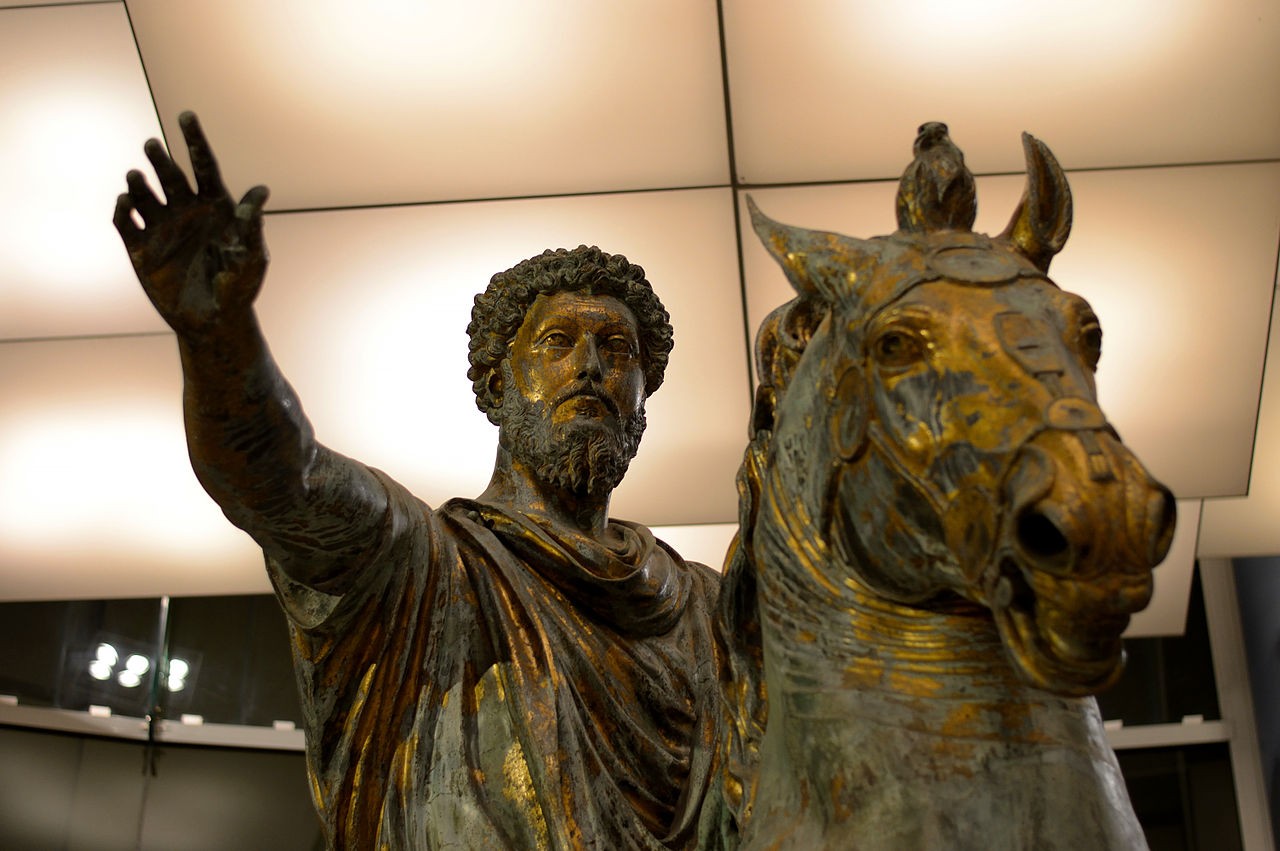
Como estudioso da filosofia antiga e estóico praticante, encontrei grande consolo nas obras de filósofos estóicos romanos, como Marco Aurélio, imperador de Roma e Epicteto, professor de filosofia estóica e ex-escravo.
Que ferramentas esses antigos pensadores oferecem para lidar com a depressão?
Claro, devo acrescentar aqui que a depressão clínica, que é um grave problema de saúde e deve ser tratada por um profissional, é uma questão diferente do tipo de depressão e fadiga comuns que a maioria de nós pode sentir de vez em quando.
O que é estoicismo? O estoicismo baseia-se na ideia de que o objetivo da vida é viver de acordo com a natureza. A própria natureza é definida como todo o cosmos, incluindo os nossos semelhantes.
Epicteto, cuja escola de estoicismo floresceu no segundo século d.C., nos disse como seguir essa ideia. Ele disse: "Algumas coisas estão sob nosso controle e algumas coisas não estão sob nosso controle". E, se algo não estiver sob nosso controle, não vale a pena gastar energia.
No entanto, havia dias, mesmo para esses pensadores, quando eles achavam difícil continuar com seus deveres. Marco Aurélio, que, como imperador do Império Romano de 161-180 d.C era o homem mais poderoso do mundo, deixa claro em uma das passagens de suas Meditações, que ele está lutando para sair da cama. Então, ele diz a si mesmo:
"Estou crescendo para fazer o trabalho de um ser humano. Por que, então, sou tão irritável se eu sair para fazer o que nasci para fazer e o que trouxe para este mundo? Ou fui criado para isso, deitar na cama e me aquecer sob a roupa de cama? "
Ele também reconhece como essa exortação pode ou não ser efetiva alguns dias. Então, mesmo que ele se arraste para o mundo, Marco destaca o que ele pode enfrentar:
"Diga a si mesmo no início do dia, eu vou encontrar com pessoas intrigantes, ingratas, violentas, traiçoeiras, invejosas e insociáveis".
Embora essa observação possa parecer não ser muito útil, na medida em que foca a atenção em todas essas possibilidades e dificuldades negativas, há aqui um ponto estóico muito importante. Alguém pode perguntar, por que se lembrar das dificuldades será benéfico?
Encontrando o mundo em termos estóicos O filósofo estóico Epicteto fornece uma resposta — pode nos ajudar a antecipar as possibilidades e nos preparar para o que está por vir. Ele diz no Enchiridion:
"Quando você está prestes a realizar alguma ação, lembre-se de que tipo de ação é. Se você for tomar um banho, pergunte o que acontece nos banhos — há pessoas que explodem, pessoas que se empurram, pessoas insultantes, pessoas que roubam. E você assumirá a ação de forma mais segura se, desde o início, você disser: 'Quero tomar um banho e manter minhas escolhas de acordo com a natureza'; e também para cada ação ".
O exemplo de Epicteto do banho romano pode ser adaptado a um contexto contemporâneo considerando o tipo de coisas que podem acontecer no trabalho, enquanto viaja ou em casa.
Epicteto está nos dizendo para estarmos preparados para enfrentar situações com uma atitude realista em relação ao que realmente são as coisas.
Marco Aurélio fornece orientações mais específicas sobre como responder.
"Eu, então, não posso ser prejudicado por essas pessoas, nem ficar irritado com alguém que é semelhante a mim, nem posso odiá-las, pois fomos juntas para trabalhar juntas, como pés, mãos, pálpebras ou as duas fileiras de dentes em nossas mandíbulas superiores e inferiores. Trabalhar uns contra os outros é, portanto, contrário à natureza; e estar com raiva de outra pessoa e afastar-se dela certamente trabalhará contra ela".
Em tudo isso, o que esses filósofos estão nos lembrando é que viver de acordo com a natureza é reconhecer que, mesmo os indivíduos mais difíceis daqueles que podemos encontrar, no decorrer de um dia, podem ser como nós — alguém que talvez esteja lutando com os seus próprios mal-estar ou doenças.
Ao reconhecer isso, é mais fácil perdoar aqueles com quem discordamos. Mas, mais do que isso, talvez seja mais fácil tolerar-nos. Isso nos ajuda a reconhecer o sofrimento e o ser humano.
Sofrimento e sua solução Essa ideia ecoa quando Epicteto explica a origem do sofrimento humano:
"O que perturba as pessoas não são as coisas em si, mas seus julgamentos sobre as coisas".
Estar chateado com algo não é uma função do que parece "chateante"; Em vez disso, é o julgamento sobre essa coisa que causa a angústia.
Os julgamentos, e não as coisas ou eventos externos, são a fonte do sofrimento humano.
O remédio a tudo isso, de acordo com Epicteto, é realmente apenas uma mudança de atitude em relação às coisas que acontecem. Quando pudermos enfrentar o dia com pleno reconhecimento do que esse dia poderia implicar e reconhecer que ainda devemos continuar, poderemos avançar.
Isso pode significar deixar a concepção de como as coisas deveriam ser e aceitá-las pelo que são, mesmo as mais frustrantes e deprimentes.
Então, "o trabalho de um ser humano" pode não parecer tão assustador.
*Professor Associado, Filosofia, Universidade de Wyoming, nos Estados Unidos. Texto publicado originalmente em inglês no The Conversation. Republicado em Revista Galileu.
Søren Kierkegaard famously pointed out that the only way we can understand life is backwards – we are compelled to live moving forwards, but attempt understanding by looking at what has happened. Perhaps he had Hegel’s Owl of Minerva that only flies at dusk in mind here. For Hegel, as history unfurls we collectively come to a moment of self-consciousness and understanding of what has transpired on a grand scale – symbolised by the Owl’s wisdom. Kierkegaard, a fierce opponent of Hegelianism, was interested in the individual’s experience and not epochal movements in history. Yet, as he made clear, his insight that we individually live forwards and understand backwards doesn’t make things any easier. We’re constantly moving forwards (until death), so we never achieve a perfect resting point from which to look back.
The future is the stuff of planning and daydreams. We all spend many days of our lives musing on it, despite the injunctions of mindfulness gurus to live in the present. In the next hour you’ll probably start thinking about things you need to get on with, and even the words ‘in the next hour’ will probably have triggered thoughts about your immediate future. If we did just live in the moment, in the now, we would lack motivation to go forward, lack direction, and would stumble from one situation to the next. We would probably leave the house without an umbrella, miss appointments, and not have any food in the refrigerator when we got home. Some of us do live like that, but that’s hardly a good thing. Yet the paradox of planning is that we both need to do it, and haven’t really got much of an idea how things will turn out – so much of it feels like a waste of time. Even our rough predictions, based on what seems like good evidence, can be wildly inaccurate.
In his recent book What We Cannot Know, the mathematician Marcus du Sautoy demonstrates the complexity of predicting something as straightforward as the trajectory of a cube, a die, thrown from a known height. The way this object will bounce and spin is extremely difficult to predict even when we know a great deal about the physics involved. The same is true of a double pendulum (a pendulum with a hinged arm). A miniscule difference of angle in the throw will produce radically different results for both the cube and the pendulum. The pendulum might swing smoothly, or go into a complex pattern of backwards and forwards spinning, when dropped from almost exactly the same height. Close analysis of the casino croupier’s angle of throw is unlikely to predict accurately the numbers that will show up on the dice; and knowing roughly the height from which a double pendulum is released does not allow a physicist to give an accurate approximate estimate of its trajectory. This is disconcerting for anyone brought up to believe that scientific prediction of physical systems is pretty straightforward.
Chaos Theory is the branch of mathematics that has developed to describe such situations: we are surrounded by systems that are in principle predictable if we know a great deal about starting conditions, but where in practice accurate prediction is impossible because tiny differences in the present produce such divergent outcomes. This is sometimes known as the ‘butterfly effect’ after the metereologist Edward Lorenz, who asked in 1972: “Does the flap of a butterfly’s wings in Brazil set a tornado in Texas?” He didn’t necessarily think that it did. His question was: given the complexity of causes affecting the weather, is it possible that significantly different meteorological conditions in the US could be caused by even something as gentle and small-scale as the flap of an insect’s wings thousands of miles away? The reason he asked this was because the weather seemed to be a case study in the difficulty of predicting outcomes from approximations.
There is no mysterious ‘chance’ operating here. As David Hume pointed out in the 18th century, we use the word ‘chance’ where we are ignorant of causes. Putting things down to ‘chance’ is just a way of saying we’re not quite sure what’s going on. But with complex systems like the one that gives rise to a tornado, approximate knowledge of the starting conditions may not be sufficient to make even approximate predictions of the outcome (in this case a tornado), since minute differences can be responsible for the system tipping over into one state or another. Lorenz put this nicely in his definition of Chaos:
“When the present determines the future, but the approximate present does not approximately determine the future.”
In my lifetime so much that has happened wasn’t foreseen. So much could have turned out completely differently. In the year I was born, the Cuban Missile Crisis could so easily have escalated to a nuclear war between superpowers. When I was at school in the 1970s, only the most fanciful of sci-fi authors would have imagined the level of interconnection and global communication made possible by the Internet. The idea that many people would be carrying a small computer in their back pockets, or that there would be driverless cars on the road, would have struck most people as far-fetched.
Today, many people are confidently predicting that robots and computers will soon be doing most jobs. Some are worried that artificial intelligences will take over the world, and won’t have much patience with the comparatively limited intellectual capacities of human beings. Yet who knows what will really happen? Clever people make huge mistakes in their predictions. The philosopher Ludwig Wittgenstein, who had trained as an aeronautical engineer, and was cleverer than most, declared that no one would ever reach the Moon only a few decades before someone actually did.
The solution isn’t to avoid thinking about the future. The solution isn’t to stagger with our eyes closed into disaster. We need to make predictions. We need to contemplate what might happen; what is likely to happen; what might happen if things go horribly wrong. Weather forecasters carry on forecasting, aware that their predictions can occasionally be wildly off the mark for the reasons that Lorenz pinpointed. Like weather forecasters, we should recognise how chaos plays a part in life, and how difficult an activity prediction can be. And like weather forecasters, we need to keep revising our predictions in the light of new evidence in a fast-changing environment. We need to be sensitive to subtle shifts in the present that might have far-reaching implications in the future.
“What’s the worst that could happen?” It’s a question favoured by Cognitive Behavioural Therapists as a way of limiting fear of failure, and one worth asking even if we don’t know the accurate odds of the worst-case scenario coming to pass. Individually and collectively, worst-case scenario risk planning might be what saves us. At worst it will mean we prepare for some disaster that never materialises. There is still the risk, of course, that something much worse than anything we can now imagine takes place. There is the risk too that we will become gloomy and fearful of the future, a state of mind that may itself affect outcomes and limit our success. Rather than encourage that, it might be better to balance out worst-case scenario thinking with musing about the best that could happen. We should spend some time daydreaming about a utopian future to have an ideal to aim at too. There’s always the chance that a flapping butterfly wing somewhere might just tip us over into conditions that move us a step towards that future.

 orcid.org/0000-0002-3614-6314